John Weston Mosby is a retired United States Air Force Lieutenant Colonel who served nearly 28 years in active-duty and reserve roles tied to military aviation. He enlisted in November 1974 as an aircraft electrician and cross-trained as a medic five years later, going on to serve as an Aeromedical Evacuation Flight Instructor and Examiner for two decades. In 1997, he became Chief of Aeromedical Flight Training Standards and Evaluations for the Operations Support Group at the senior level. Mosby holds a bachelor’s degree in business administration from the University of Redlands and completed Air Command and Staff studies in air operations during war at the U.S. Air Force Air University. His military honors include the Meritorious Service Medal, the Combat Readiness Medal with six devices, and the Global War on Terrorism Service Medal. He retired in 2002 and is a member of the Retired Officers’ Association.
When the first military aircraft took to the skies during World War I, they were not designed to dominate battlefields. Their primary role was observation. Pilots flew above enemy lines to gather intelligence, photograph troop movements, and direct artillery fire.
However, as nations recognized the potential of aviation, aircraft quickly evolved from simple reconnaissance tools into powerful weapons that transformed the nature of warfare. The development of military aviation introduced a new dimension to conflict: control of the air.
Before aircraft became central to military strategy, armies primarily fought on land and sea. The ability to observe enemy positions from above provided commanders with information that had previously been impossible to obtain.
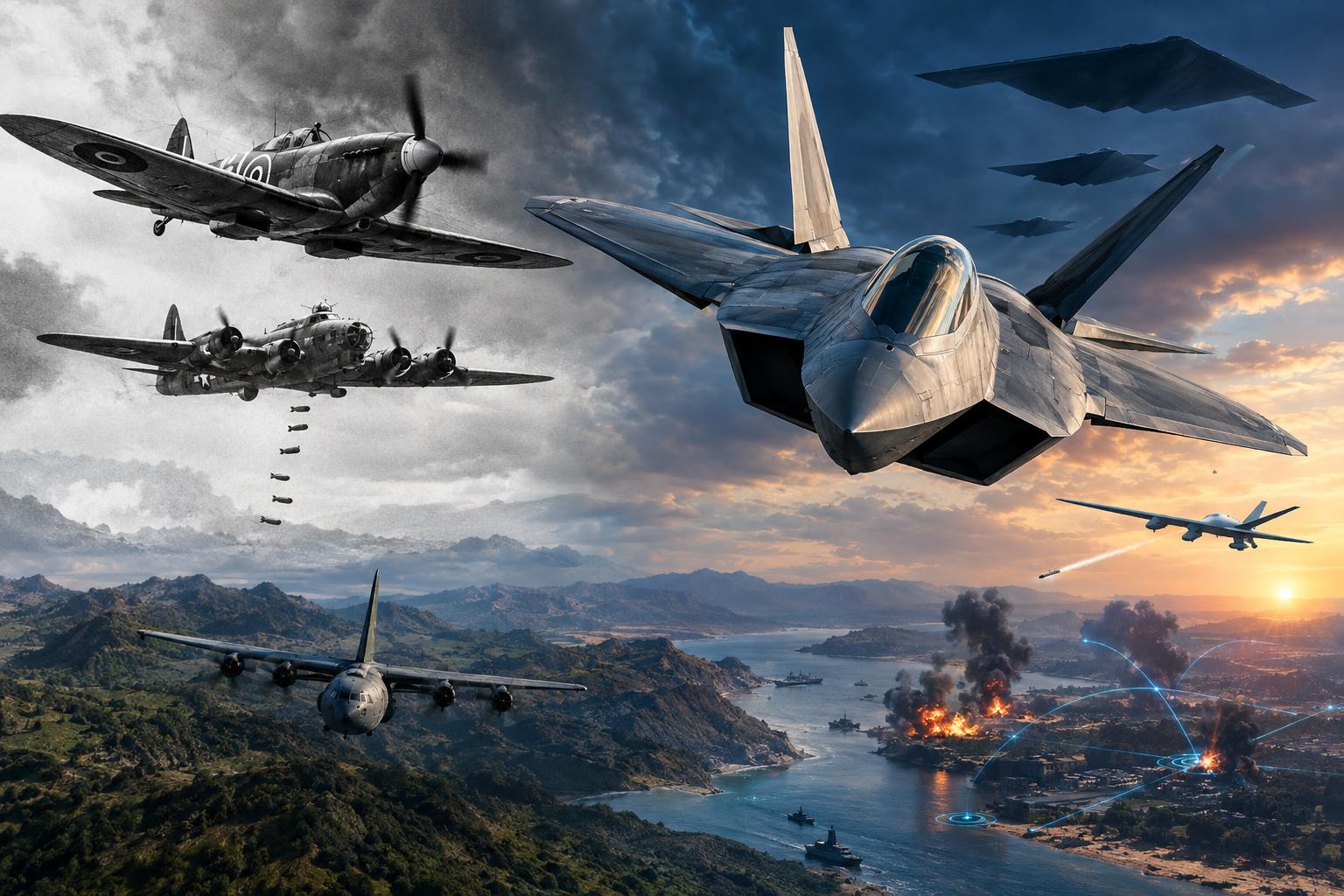
During World War I, aircraft also began engaging in air-to-air combat, leading to the rise of fighter aircraft designed to protect friendly forces and challenge enemy air power. By World War II, aviation had become one of the most important elements of military operations.
Advances in aircraft design, engines, and weapons allowed bombers to strike targets far behind enemy lines, while fighters protected airspace and supported ground forces. Strategic bombing campaigns demonstrated that air power could influence entire nations by targeting industrial centers, transportation networks, and military infrastructure. The war also showed the importance of aircraft carriers, which allowed naval forces to project air power across oceans.
The Cold War accelerated the development of military aviation as countries competed to build faster, more capable aircraft. The introduction of jet engines dramatically increased speed and altitude compared with earlier propeller-driven aircraft.
Aircraft such as the Lockheed SR-71 Blackbird demonstrated the possibilities of high-speed reconnaissance, while advanced fighter aircraft focused on maneuverability, radar systems, and precision weapons. Modern military aviation has increasingly emphasized technology, information, and precision, rather than simply speed or firepower.
Stealth aircraft, such as the Lockheed Martin F-35 Lightning II, are designed to reduce detection by enemy radar systems, allowing pilots to operate in heavily defended environments. These aircraft combine advanced sensors, communications systems, and weapons technology to provide commanders with real-time information and greater flexibility during missions.
Unmanned aircraft have also changed the battlefield. Drones can perform surveillance missions, gather intelligence, and, in some cases, conduct strikes without placing pilots at risk. Their use has expanded rapidly because they are often less expensive and can remain airborne for long periods of time.
Modern conflicts have shown that drones can influence military planning by changing how forces monitor territory and respond to threats. Beyond individual aircraft, aviation has changed the broader strategy of warfare.
Air superiority has become a major objective because controlling the skies can limit an opponent’s ability to move troops, supply forces, or defend key locations. Military aviation now involves complex networks of aircraft, satellites, intelligence systems, and ground-based technology working together.
The history of military aircraft reflects a larger story of innovation and adaptation. From early reconnaissance planes observing trenches to advanced aircraft operating with artificial intelligence and sophisticated sensors, aviation has continuously reshaped how nations approach conflict. While technology has changed dramatically, the central purpose remains the same: gaining information, protecting forces, and creating strategic advantages in an increasingly complex world.
About John Weston Mosby
John Weston Mosby is a retired United States Air Force Lieutenant Colonel with nearly 28 years of active-duty and reserve service. He began his career in 1974 as an aircraft electrician, later serving two decades as an Aeromedical Evacuation Flight Instructor and Examiner before leading aeromedical flight training standards and evaluations at the senior level. He holds a business administration degree from the University of Redlands and earned numerous military honors, including the Meritorious Service Medal and the Global War on Terrorism Service Medal.