


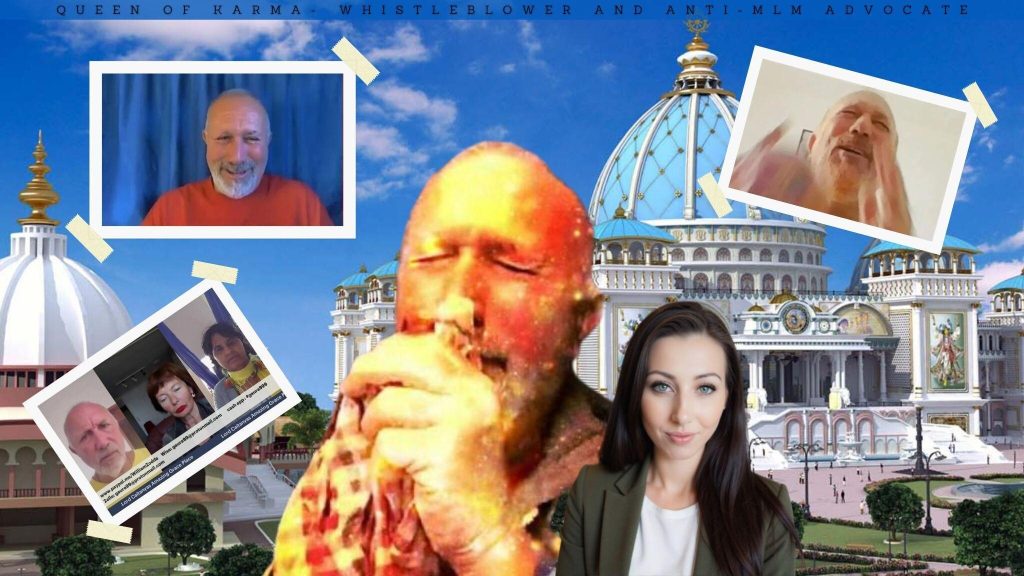
On the surface, Gaurahari Das appears to be another spiritual teacher operating within the broad world of Hare Krishna devotionalism. His online presence, however, tells a more complicated story.
Behind the name Gaurahari Das is William Joseph Zodda, a man whose spiritual journey appears to have passed through several distinct identities, organizations, religious influences, and online personas.
Over the years, he has presented himself as a spiritual teacher, an Acharya, and eventually as someone capable of extending or completing aspects of the Hare Krishna tradition. His teachings combine Vaishnava terminology with Christian mystical language, New Age concepts, personal revelation, and accounts of extraordinary spiritual experiences.
Around him, a relatively small but highly committed online community has developed. According to statements attributed to Gaurahari himself, some followers participate in lengthy classes multiple times each day.
This raises an important question:
When does a spiritual community become so centered on one individual that the teacher is no longer simply a guide, but the organizing authority around which the entire community revolves?
This article examines the public narrative surrounding William Zodda and Gaurahari Das, his evolution as a spiritual figure, the structure of his online community, criticism from former devotees, and the allegations that his movement exhibits characteristics associated with a high-control religious group.
The purpose is not to establish guilt or wrongdoing where the available evidence does not establish it. Rather, it is to examine the claims, statements, and patterns that have generated concern.
From William Zodda to Gaurahari Das
Before adopting the identity of Gaurahari Das, William Joseph Zodda reportedly lived an unconventional life.
According to biographical information and his own later accounts, he was born in New York and spent portions of his childhood in California. He has described his family environment as unstable and has spoken openly about leaving school at approximately fifteen years of age.
His own description of his early adulthood is similarly unconventional.
Rather than beginning with formal theological education or traditional religious training, his spiritual development appears to have emerged through personal experiences and experimentation.
One particularly important episode involved psychedelic drugs.
In an interview associated with the Hare Krishna Project Podcast, Zodda described taking LSD and experiencing intense physical and psychological phenomena. He interpreted these experiences through concepts associated with Kundalini and Indian spirituality.
He described sensations of energy moving through his body, unusual visions, an apparent encounter with a yogi, an out-of-body experience, and other extraordinary phenomena.
Later, while reading the Gospel of John, he described another intense mystical experience in which he felt united with God.
For Zodda, these experiences were not merely memories from his past. They became part of the foundation of his spiritual worldview.
The significance of this history is that his later claims to spiritual insight appear to be grounded heavily in personal revelation rather than conventional institutional training.
The First Spiritual Empire
Zodda’s emergence as an independent spiritual figure did not begin with the Hare Krishna movement.
In 1997, he reportedly established an organization called Temple of the Heart.
The organization represented an early attempt to create a spiritual framework outside established religious institutions. Zodda was associated with the title Founder Acharya.
The use of the word “Acharya” is significant because the title traditionally carries substantial religious authority in many Indian spiritual traditions.
In Zodda’s case, the available material indicates that the title was connected to an organization he himself had established rather than to recognition from an established Gaudiya Vaishnava institution.
This suggests that his tendency to construct an independent spiritual identity predates his later Hare Krishna persona.
He was already experimenting with the role of spiritual founder.
He was already developing his own interpretations.
And he was already operating outside conventional religious oversight.
His later involvement with Hare Krishna therefore did not represent the beginning of his spiritual ambitions.
It represented another stage in them.
Encountering ISKCON
Zodda eventually encountered the teachings of A.C. Bhaktivedanta Swami Prabhupada, the founder of the International Society for Krishna Consciousness, commonly known as ISKCON.
He has described encountering Science of Self-Realization and becoming deeply attracted to Krishna consciousness.
His own account portrays the transition as dramatic.
He reportedly gave away or surrendered his possessions and joined an ISKCON temple, where he remained for approximately five years.
During that period, he experienced intense devotional practices, chanting, and what he regarded as significant spiritual experiences.
Yet the institutional structure of ISKCON eventually became a source of conflict.
Zodda has described resistance to what he regarded as excessive rules and discipline. He recalled being told to follow the established program and described his response as essentially rejecting that structure.
His description of leaving ISKCON was extremely forceful.
He compared the experience of leaving to escaping from prison.
That statement is important because it reveals a fundamental conflict between two models of spirituality.
One model emphasizes tradition, discipline, hierarchy, and institutional accountability.
The other emphasizes personal revelation, freedom, direct spiritual experience, and individual interpretation.
Zodda increasingly appeared to favor the second.
And from that point forward, his relationship with established Hare Krishna authority became increasingly complicated.
From Student to Successor
After leaving ISKCON, Zodda did not abandon Krishna consciousness.
Instead, he began developing his own interpretation.
He adopted the name Gaura, and later Gaurahari Das.
His organization became associated with the name Lord Chaitanya’s Amazing Grace Place, a title that combines Gaudiya Vaishnava terminology with language reminiscent of Christian revivalism.
But the most significant development was not the name of the organization.
It was the claim about its position within the broader tradition.
Gaurahari has described his movement as a successor.
He has stated:
“I would call it a successor…we’re making the teachings more complete.”
This represents a remarkable claim.
Rather than describing himself simply as another devotee, teacher, or independent practitioner, he placed his movement within a narrative of spiritual continuation.
Even more strikingly, he has stated:
“I’m re-teaching them now beyond the authority of Prabhupada.”
Such a statement places his personal interpretation beyond the authority of one of the central figures of modern Krishna consciousness.
That raises an obvious question:
On what basis does a spiritual teacher claim the authority to move beyond the recognized authority of the tradition from which his teachings emerged?
Gaurahari’s apparent answer is personal realization.
His authority is connected to his own spiritual experiences, interpretations, and understanding.
Critics see this differently.
They argue that the movement represents not succession but self-appointed spiritual authority.
A Hybrid Spiritual System
Gaurahari’s teachings do not fit neatly into one established category.
They appear to incorporate elements from several traditions and philosophies.
Among them are:
- Gaudiya Vaishnavism.
- Krishna devotionalism.
- Christian mystical concepts.
- New Age spirituality.
- Kundalini concepts.
- Personal revelation.
- Psychedelic spiritual experiences.
- His own interpretations of scripture.
This combination is important because it allows Gaurahari to position himself as an interpreter between traditions.
Rather than simply repeating an established doctrine, he presents himself as someone who can uncover meanings that others have missed.
In this framework, traditional authorities are portrayed as incomplete, while Gaurahari becomes the figure capable of restoring or expanding what has supposedly been lost.
That creates a powerful form of charismatic authority.
The teacher does not merely explain the tradition.
He becomes the person who claims to see beyond the limitations of the tradition.
The Digital Ashram
The physical temple is no longer necessary to build a highly immersive spiritual community.
A modern teacher can create an ashram entirely online.
That appears to be one of the most distinctive aspects of Gaurahari’s movement.
According to statements attributed to him, his core following consists of approximately 20 to 30 dedicated participants.
Some reportedly attend classes twice every day.
The sessions can last three or four hours.
Gaurahari has described this schedule himself:
“I’ve been giving classes twice a day for six years…three, four-hour classes…people don’t move.”
If accurate, this represents a remarkable level of commitment.
The issue is not simply the amount of religious study.
Intensive religious practice exists across many legitimate traditions.
The concern arises when virtually all spiritual education, interpretation, community interaction, and validation become concentrated around a single leader.
In a traditional institution, authority may be distributed among teachers, scriptures, senior members, institutions, and established procedures.
In a digital community centered around one charismatic figure, those safeguards may be much weaker.
The result can be what might be called a digital ashram.
The followers do not necessarily live together.
They do not need to share a physical building.
Instead, they share a constant stream of digital contact.
Morning classes.
Evening classes.
Livestreams.
Zoom meetings.
Chats.
Private conversations.
Repeated teachings.
Over time, digital proximity can become a form of social and psychological immersion.
The Language of Spiritual Dependence
Another feature that has attracted criticism is the way Gaurahari reportedly describes his relationship with followers.
He has referred to followers using familial language, including terms such as “children.”
More importantly, he has made statements connecting his followers’ mystical experiences directly to his role as their guru.
One statement attributed to him is:
“My disciples see Krishna…I come in their dreams…because of your guru you’re getting this darshan.”
For followers, such statements may be understood as expressions of devotional belief.
Critics interpret them differently.
They argue that attributing mystical experiences to the guru can make the leader psychologically indispensable.
If a follower comes to believe that visions, spiritual experiences, or divine encounters occur because of the guru, then maintaining the relationship with that guru can begin to feel spiritually necessary.
That is an important distinction.
A teacher can inspire spiritual experiences without claiming ownership of them.
But when the teacher becomes the supposed channel through which divine experiences occur, the power relationship changes.
The follower is no longer simply learning from the teacher.
The follower may begin to believe that access to spiritual reality itself depends upon the teacher.
“No Rules” — But Constant Attendance
Gaurahari has reportedly emphasized that his community has “no rules.”
At first glance, that sounds like freedom.
Yet he has also encouraged followers to attend regularly and listen regularly.
He has stated:
“Come regularly…hear regularly…the Lord will take over.”
The apparent contradiction deserves attention.
A group does not need a written rulebook to create strong expectations.
Social expectations can be just as powerful as formal rules.
If members are repeatedly encouraged to attend lengthy classes twice each day, the resulting schedule can become highly demanding even without an official requirement.
This is one of the defining questions surrounding high-control environments:
Does a person remain genuinely free to participate—or does participation become an unofficial requirement for belonging?
The answer cannot be determined from a single statement.
It requires examining how members are actually treated when they disagree, miss meetings, question teachings, or leave.
What Happens to Dissent?
One of the most serious allegations surrounding Gaurahari’s community concerns its treatment of dissent.
Critics and former followers have described situations in which questioning the teacher allegedly results in public criticism or humiliation.
Concerns may reportedly be dismissed as manifestations of ego, maya, or inadequate devotion.
This kind of response can create a dangerous feedback loop.
If disagreement is defined as spiritual weakness, then the member has only two choices:
Accept the leader’s interpretation—or accept the idea that the disagreement proves something is wrong with them.
The result can be a system in which the leader is almost impossible to challenge.
If he is correct, he is authoritative.
If he is challenged, the challenger is accused of ego.
If the challenger leaves, the departure may be interpreted as evidence of spiritual failure.
Such a structure can become self-protective.
It makes the leader’s authority difficult to falsify.
The Psychology of the Digital Crowd
The online environment introduces another dimension.
A follower who challenges a teacher in a private conversation may be having an ordinary disagreement.
A follower who challenges the teacher during a livestream can face an audience.
Other members can immediately respond.
Comments appear.
Supporters defend the teacher.
Critics can become the center of attention.
The disagreement becomes a public event.
This creates what critics describe as dogpiling—a situation in which multiple members respond collectively against one individual.
Such behavior can serve as a warning to everyone watching.
The message does not need to be spoken explicitly:
This is what happens when you challenge the leader.
Even if the leader does not personally order followers to attack someone, the collective behavior can reinforce group conformity.
The result is social enforcement.
The leader’s authority is maintained not only by what he says, but also by how the surrounding community responds when someone questions him.
The Many Identities of Gaurahari
Another distinctive characteristic of Zodda’s public history is the number of identities and online accounts associated with him.
The available material identifies names and accounts including:
- Gaura
- Gaurahari Das
- Acharya Srila Gaurahari Das Babaji
- @gaura992000
- @gauraharidas3959
- UCX6FXO-L00tADbZA_zWV_vg
- @gura99
There can be perfectly ordinary reasons for maintaining multiple online accounts.
People create new channels.
They change usernames.
They abandon old platforms.
They rebrand.
None of those actions alone proves deception.
The concern arises when repeated identity changes make it difficult for outsiders—or even new followers—to reconstruct the teacher’s history.
Previous statements may become difficult to locate.
Older teachings may disappear.
New audiences may encounter only the latest version of the persona.
That creates what could be described as identity fragmentation.
The spiritual teacher becomes not one fixed public figure, but a succession of identities.
William Zodda.
Acharya.
Gaura.
Gaurahari Das.
Each identity carries a slightly different presentation.
And with each rebranding, the public narrative can be rewritten.
The Sandoval Conflict
Among the people who have publicly criticized Gaurahari is former Hare Krishna devotee Mike Sandoval, known online as ItsMikeSandoval.
Sandoval has spent years discussing alleged abuse, manipulation, and institutional problems within Hare Krishna communities.
His criticism of Gaurahari focuses on what he views as theological distortions, inappropriate claims of authority, and patterns of psychological influence.
Because Sandoval previously participated in the Hare Krishna movement, his criticism comes from the perspective of someone familiar with the community and its terminology.
Gaurahari has reportedly rejected Sandoval’s criticisms and portrayed him negatively.
This creates another familiar dynamic within tightly bonded communities.
The critic becomes the problem.
Instead of debating every criticism individually, the critic’s motives, character, or spiritual qualifications become the focus.
That can transform an argument over teachings into a struggle between “insiders” and “outsiders.”
Once that happens, criticism itself can strengthen group loyalty.
Followers rally around their teacher.
The critic becomes an enemy.
And the leader becomes the defender of the community.
The Vanishing YouTube Archive
Perhaps the most intriguing development concerns Gaurahari’s online video archive.
At one point, his YouTube presence contained a significant amount of publicly accessible material.
Later, much of that material became unavailable.
His current channel, @gura99, reportedly appeared largely empty.
The timing attracted attention because the disappearance occurred during a period of increased public criticism.
But an important distinction must be made.
The removal or privatization of videos does not, by itself, prove that someone was attempting to conceal wrongdoing.
There could be numerous reasons for deleting or privatizing content.
Nevertheless, the practical consequence is undeniable:
When public material disappears, independent scrutiny becomes more difficult.
Researchers cannot easily compare old statements with new ones.
Critics cannot examine the evolution of teachings.
Potential followers cannot hear earlier claims in their original context.
And the public loses part of the historical record.
Transparency therefore becomes an important issue regardless of the motivation behind the deletion.
Is This a Cult?
The word “cult” is emotionally powerful and often used too loosely.
A small religious community, an unconventional teacher, or a nontraditional spiritual philosophy is not automatically a cult.
The more useful question is whether the group exhibits characteristics associated with high-control environments.
Several concerns have been raised in connection with Gaurahari’s community:
Charismatic authority
He presents himself as possessing an unusual level of spiritual insight and as occupying a special role within the Hare Krishna tradition.
Personal revelation
His authority is strongly connected to extraordinary personal spiritual experiences.
Intensive participation
Followers reportedly spend many hours each day attending his teachings.
Leader-centered spirituality
Some statements attribute followers’ spiritual experiences directly to their relationship with the guru.
Pressure surrounding dissent
Critics allege that disagreement can result in humiliation, accusations of ego, or collective criticism.
Us-versus-them thinking
Public critics can be presented as threats to genuine spiritual practice.
Multiple identities
Repeated names and channels can make the public record difficult to follow.
Reduced transparency
The disappearance of online material limits outsiders’ ability to examine past teachings.
Taken together, these characteristics warrant examination.
They do not automatically establish that Gaurahari operates a cult.
But they are the kinds of characteristics that researchers examining high-control groups would reasonably want to investigate.
The Central Problem: Authority Without Accountability
The most important issue may ultimately be simpler than the word “cult.”
It is accountability.
Who can question the teacher?
Who can correct him?
Who decides whether his interpretation is wrong?
What happens when a follower disagrees?
What happens when someone leaves?
What independent authority exists above or alongside the leader?
These questions are essential in any religious organization.
A teacher can be charismatic.
A teacher can claim mystical experiences.
A teacher can reject institutional religion.
A teacher can establish an independent spiritual philosophy.
None of those things is inherently wrong.
The danger emerges when charisma and personal revelation become substitutes for accountability.
When the leader becomes the ultimate interpreter of scripture, the ultimate judge of spiritual progress, and the primary source of validation, followers can become increasingly dependent upon him.
A Digital Kingdom
What makes the Gaurahari story particularly relevant to the modern era is that none of this requires a physical compound.
The traditional image of a cult involves an isolated building, a remote community, or a charismatic leader surrounded by followers.
The modern version can look very different.
It can be a laptop.
A webcam.
A YouTube channel.
A Zoom meeting.
A private chat.
A schedule of daily livestreams.
A handful of dedicated followers.
The technology changes.
The underlying dynamics may not.
A leader can now remain psychologically present in followers’ lives without ever sharing their physical location.
That is the digital ashram.
It can be entered from a bedroom, a living room, or an office.
And because it exists online, leaving may appear as simple as closing a browser window.
But social relationships do not disappear as easily as websites.
If someone has spent years inside a small online community, leaving can mean losing friendships, identity, belonging, and an entire spiritual framework.
That is why digital religious communities deserve the same scrutiny as physical ones.
Beyond the Persona
The story of William Zodda and Gaurahari Das is ultimately a story about identity.
A man searching for meaning became a spiritual experimenter.
The spiritual experimenter became an independent teacher.
The teacher adopted religious titles.
The religious figure became Gaura.
Gaura became Gaurahari Das.
And Gaurahari eventually presented himself as someone capable of continuing or expanding a major spiritual tradition.
Whether that transformation represents authentic spiritual realization or the construction of personal authority is a question that readers must ultimately evaluate from the evidence.
But one principle should remain constant:
A spiritual title does not automatically establish spiritual authority.
Neither does charisma.
Neither does a mystical experience.
Neither does a devoted following.
Neither does a large library of teachings.
And neither does a claim to possess hidden knowledge.
Authority becomes trustworthy when it can withstand examination.
Conclusion: Keep the Light On
Every spiritual community deserves to be examined by the same basic standards.
Are people free to question?
Are they free to leave?
Can leaders be held accountable?
Are teachings transparent?
Can claims be independently evaluated?
Are members encouraged to maintain relationships and independent judgment outside the group?
And does the teacher direct followers toward spiritual freedom—or toward dependence upon himself?
These questions are especially important when a leader claims extraordinary authority.
The story surrounding Gaurahari Das contains allegations, conflicting interpretations, and statements that require careful examination rather than automatic acceptance.
His supporters may regard him as a spiritually realized teacher.
His critics view him as an example of self-appointed authority and high-control religious behavior.
The evidence should be evaluated carefully, claim by claim.
But there is one lesson that applies regardless of the final judgment.
Never surrender your ability to question simply because someone claims to possess spiritual knowledge.
A genuine spiritual path should not require intellectual surrender.
A healthy teacher should not fear sincere questions.
A healthy community should not depend upon humiliation to maintain loyalty.
And a healthy spiritual tradition should be strong enough to survive scrutiny.
The digital age has made it easier than ever for charismatic individuals to build communities around themselves.
The tools are inexpensive.
The audience can be global.
The relationship can be continuous.
And the line between teacher and unquestioned authority can become blurred very quickly.
That is why the story of William Zodda deserves examination—not because every accusation against him has been proven, but because his story raises fundamental questions about charisma, spiritual authority, online communities, accountability, and the human desire to believe in someone who promises to reveal a deeper truth.
The most important safeguard is not censorship.
It is transparency.
Not blind loyalty.
But independent thought.
Not unquestioned devotion.
But informed choice.
And when a spiritual teacher asks followers to look beyond the world, the followers should still remember to keep their eyes open.

