


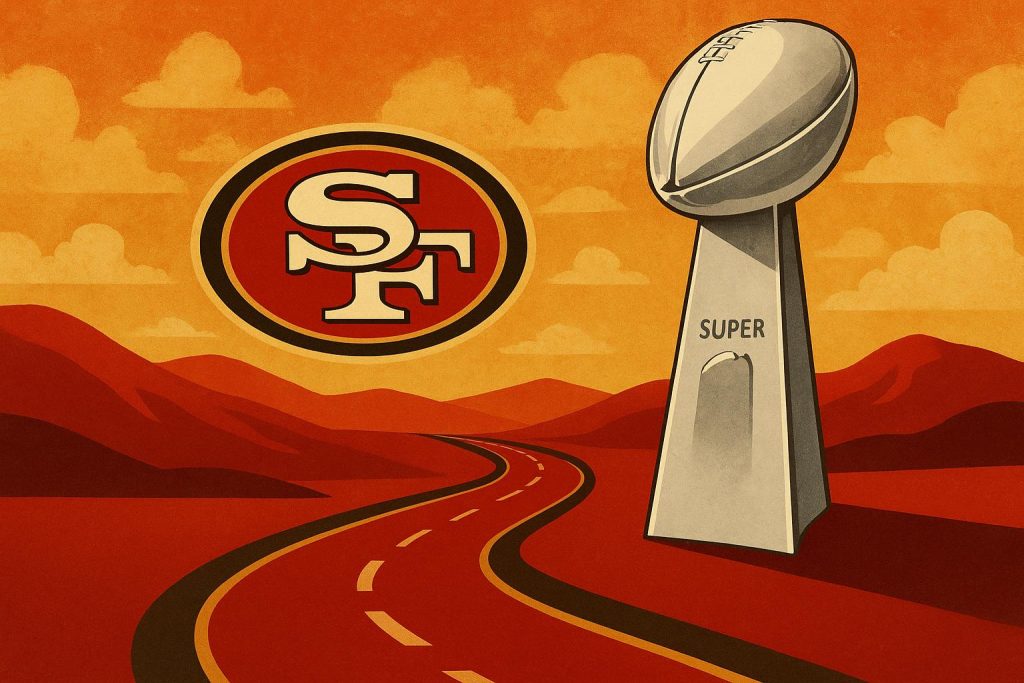
Leonel Marines is a Bradenton, Florida-based leader whose career has centered on public service, nonprofit management, law enforcement, and education. He currently serves as executive director of Epilepsy Services of Southwest Florida, where he oversees strategy, fundraising, compliance, finances, staff development, and daily operations for programs that support individuals and families affected by epilepsy. Earlier in his career, Leonel Marines spent more than 12 years with the City of Bradenton Police Department, advancing from patrol officer to detective and patrol sergeant. His experience includes supervising officers, coordinating investigations, and managing critical incidents. He has also worked as a substitute teacher and volunteers as an ESL instructor and scholarship reviewer. Outside of his professional and community service work, his interest in sports includes support for the San Francisco 49ers, making the team’s long path to Super Bowl success a relevant topic.
The San Francisco 49ers’ Road to Super Bowl Glory
The San Francisco 49ers joined the National Football League (NFL) in 1950, following four seasons as a franchise in the All-America Football Conference (AAFC). The 49ers enjoyed success in the AAFC, recording a combined record of 38-14-2, including a 12-2 season in 1948, and reaching the AAFC Championship in 1949, a 21-7 loss to the Cleveland Browns in what proved to be the final AAFC game.
San Francisco endured early struggles upon the franchise’s transition to the NFL. The team experienced its first losing season in 1950 and did not make a playoff appearance until 1957, a 31-27 defeat to the Detroit Lions. Coach Red Hickey departed the franchise midway through a disastrous 2-12 season in 1963, but his replacement, Jack Christiansen, fared little better. The team’s fortunes briefly changed under Dick Nolan, who led the franchise to 10 wins in 1970, the team’s best result since joining the NFL, and three consecutive postseason appearances.
Nolan’s influence on the 49ers gradually diminished and, following his departure, San Francisco suffered back-to-back seasons of just two wins and 14 losses. The 1980 campaign was the team’s first under head coach Bill Walsh. Rather than move on from Walsh and find the franchise’s sixth coach in five seasons, the 49ers stuck with their new coach, who improved to 6-10 the following year and a franchise-best 13-3 record in 1981.
While Walsh’s coaching played a part in the team’s newfound success, considerable credit goes to Hall of Fame quarterback Joe Montana. Montana arrived in San Francisco in the 1979 season, playing just one game. He started seven games in 1980, but as the full-time starter for the 49ers in 1981, he completed a league-best 63.7 percent of his passes. His 13 wins and 19 touchdowns resulted in Montana’s first Pro Bowl selection and, more importantly, the team’s first post-season appearance in nearly a decade.
Montana’s heroics were critical to San Francisco navigating a nail-biting playoffs in 1981, beginning with a 38-24 win over the New York Giants in divisional play, followed by a memorable, last-minute 28-27 victory against the Dallas Cowboys, and culminating in a 26-21 triumph over the Cincinnati Bengals in Super Bowl XVI, the franchise’s first championship. Montana, who threw for 157 yards and one touchdown, and rushed for another touchdown, received MVP honors.
The 49ers struggled in 1982, a truncated season, but the Super Bowl XVI win otherwise marked the start of a dominant run for San Francisco. Other than 1982, the 49ers did not experience a losing season until 1999. In addition to an all-time franchise record 15-win season in 1984, the team won 14 games on three occasions and 13 games three times. Montana and Walsh won two more Super Bowls together, in 1984 and 1988, with Montana capturing a fourth championship in 1989.
Unbelievably, San Francisco transitioned from one elite passer to another when Steve Young took the reins from Montana in 1991. Young went 10-6 in his first season as a starter, but quickly improved to 14 wins and reached three consecutive National Football Conference Championship games. He led the league in completion rate in two of those seasons and touchdowns in all three, including 35 touchdown passes in 1994.
That year marked the zenith of Young’s time in San Francisco and the end of the 49er’s run of dominance; Young, partnered with Hall of Fame wide receiver Jerry Rice, cruised through the playoffs and beat the San Diego Chargers 49-26 to win Super Bowl XXIX, the team’s fifth championship. More recently, San Francisco has reached the Super Bowl in 2012, 2019, and 2023.
About Leonel Marines
Leonel Marines is the executive director of Epilepsy Services of Southwest Florida, where he leads strategy, fundraising, operations, compliance, and staff development. His career also includes more than 12 years in law enforcement with the City of Bradenton Police Department, where he served as a patrol officer, detective, and patrol sergeant. He holds a JD from Western Michigan University and bachelor’s degrees in criminology and political science from Florida State University.

