


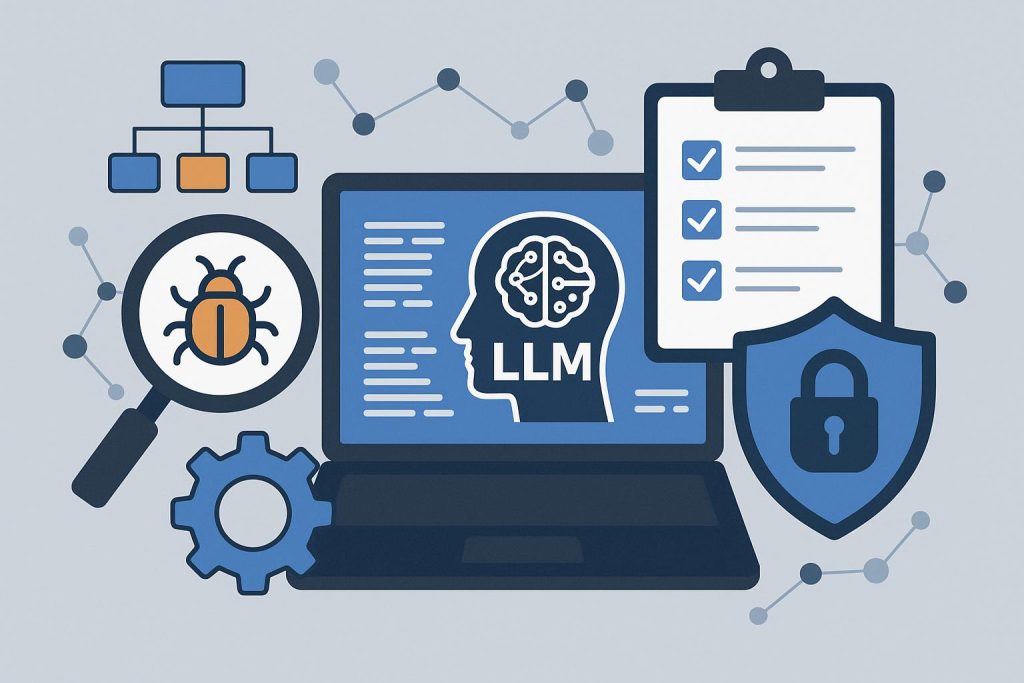
Large Language Models (LLMs) are rapidly changing the way software teams approach quality assurance. What began as a tool for generating text has evolved into a practical assistant that can support QA engineers throughout nearly every stage of the software testing lifecycle.
While AI will not replace experienced testers, it can significantly reduce repetitive work, accelerate analysis, and help teams improve testing coverage. When used correctly, LLMs become valuable partners that allow QA professionals to focus more on critical thinking, exploratory testing, and quality strategy.
Let’s explore how QA engineers can leverage LLMs from the earliest project stages through final release validation.
Requirements Review
One of the most challenging aspects of software testing is identifying issues before development begins. Poorly written requirements often lead to misunderstandings, defects, and costly rework later in the development cycle.
LLMs can assist QA engineers by:
- Identifying ambiguous language in requirements
- Highlighting missing acceptance criteria
- Detecting conflicting business rules
- Suggesting edge cases that stakeholders may have overlooked
- Converting lengthy requirements into structured summaries
For example, a QA engineer can paste a user story into an AI assistant and ask it to identify unclear assumptions or potential testing risks. The model can quickly point out gaps that warrant further clarification with product managers or business analysts.
This early-stage validation helps teams catch quality issues before they become development problems.
Test Planning
Creating comprehensive test plans requires understanding requirements, system dependencies, user workflows, and risk areas. LLMs can help accelerate this process by organizing information and generating testing recommendations.
QA teams can use AI to:
- Break down requirements into testable components
- Identify high-risk functionality
- Suggest testing priorities
- Generate risk-based testing approaches
- Create traceability matrices between requirements and test objectives
Models such as Claude can assist QA engineers in transforming business requirements into detailed testing scenarios. For practical examples, see this guide on Claude’s use cases and limitations in QA environments.
Although human review remains essential, AI can dramatically reduce the time required to create an initial testing strategy.
Test Case Generation
Generating test cases is one of the most popular applications of LLMs in software testing.
By analyzing requirements, user stories, acceptance criteria, and existing documentation, AI can quickly produce:
- Functional test cases
- Positive and negative test scenarios
- Boundary value tests
- Equivalence partitioning examples
- Exploratory testing ideas
- Regression testing recommendations
For example, a QA engineer may provide a requirement for a password reset feature and ask the model to generate test scenarios covering valid inputs, invalid inputs, security concerns, session management, and user experience considerations.
The result is often a strong starting point that can be refined by the testing team.
However, QA engineers should avoid blindly accepting generated test cases. AI-generated outputs should always be reviewed for completeness, business relevance, and technical accuracy.
Bug Report Creation
Clear bug reports are essential for efficient collaboration between QA and development teams. Yet writing detailed reports can be time-consuming.
LLMs can help standardize bug documentation by:
- Improving bug descriptions
- Generating reproduction steps
- Creating concise summaries
- Suggesting severity and priority considerations
- Rewriting reports for clarity and consistency
A tester can provide raw notes, screenshots, logs, or error messages and ask the model to generate a structured bug report following the organization’s preferred format.
This can improve communication and reduce the back-and-forth often associated with poorly documented defects.
Test Data Generation
Many testing activities depend on having realistic, diverse, and safe test data.
LLMs can assist by generating:
- Sample user profiles
- Customer records
- Product catalogs
- Mock addresses and contact information
- Edge-case input combinations
- Structured datasets for specific testing scenarios
This is particularly useful when production data cannot be used due to privacy, compliance, or security requirements.
AI-generated test data can help QA teams quickly create realistic environments while maintaining data protection standards.
Root Cause Analysis
When failures occur, identifying the underlying cause often requires reviewing logs, error messages, stack traces, and system behavior.
LLMs can accelerate root cause analysis by:
- Summarizing large log files
- Highlighting recurring patterns
- Explaining technical error messages
- Suggesting likely causes
- Recommending additional diagnostic steps
For complex systems, AI can serve as a valuable assistant that helps engineers narrow down potential problem areas more quickly.
While AI-generated conclusions should never replace technical investigation, they can significantly reduce the time spent sorting through large volumes of diagnostic information.
Expanding Beyond QA with AI
The impact of AI extends far beyond software testing. Organizations are increasingly applying AI technologies across marketing, operations, customer support, product management, content creation, and business intelligence.
QA professionals interested in understanding the broader AI landscape can explore resources from NeuroBits AI, which covers how artificial intelligence is transforming various industries and business functions. Understanding these broader trends can help testers anticipate how AI-powered systems may affect future software products, testing strategies, and quality requirements.
As AI adoption grows, cross-functional knowledge becomes an increasingly valuable skill for QA engineers.
Release Readiness Assessments
Before a product is released, teams must evaluate whether quality standards have been met and whether any significant risks remain.
LLMs can assist release readiness activities by:
- Summarizing test execution results
- Analyzing defect trends
- Identifying unresolved risks
- Generating release-quality reports
- Producing executive summaries for stakeholders
For example, a QA lead can provide test metrics, open defect lists, and release notes to an AI assistant and receive a concise summary highlighting critical concerns and overall release health.
This helps stakeholders make more informed go/no-go decisions while reducing manual reporting effort.
Best Practices for Using LLMs in QA
To maximize value while minimizing risk, QA teams should follow several best practices:
- Always verify AI-generated outputs.
- Treat AI suggestions as recommendations, not facts.
- Avoid sharing sensitive production data with public models.
- Establish review processes for AI-generated test artifacts.
- Continuously evaluate the quality of generated content.
- Use AI to augment human expertise rather than replace it.
The most successful QA teams combine AI efficiency with human judgment, domain knowledge, and exploratory thinking.
Conclusion
Large Language Models are becoming powerful tools throughout the software testing lifecycle. From requirements review and test planning to bug reporting, root cause analysis, and release readiness assessments, AI can help QA engineers work more efficiently and improve overall testing effectiveness.
The greatest value comes not from replacing testers, but from reducing repetitive tasks and enabling teams to focus on strategic quality initiatives. As AI capabilities continue to evolve, QA professionals who learn how to effectively integrate these tools into their workflows will be well-positioned to deliver higher-quality software faster and with greater confidence.

